The Veracity Trust Layer
Veracity.
Overview · Non-technical · August 2026

Proof for the knowledge you own.

Veracity makes business records that anyone can check — an auditor, a regulator, a counterparty, a court — without an account, without calling us, and without having to take our word for it.

Veracity OSNow
Veracity SignA moment
Veracity AssureOver time

The problem

Every organisation runs on documents, decisions and approvals. Very few can prove, afterwards, what was actually true.

Ask a simple question — which version of this policy was in force in March, who approved it, and what did it replace — and most businesses cannot answer without days of digging through drives, inboxes and systems.

When the answer finally arrives, it rests on the word of whoever controls the database. That is not evidence. It is a reassurance you are asked to accept.

AI has made this urgent. Teams are already running their most sensitive documents through AI tools, and every answer that comes back is unsigned, unowned and unversioned.

It is everywhere in the business — and none of it counts as evidence.

What we do

Veracity attaches the proof to the record itself, instead of storing it in a system you have to trust.

Each document, decision, approval or AI output is sealed at the moment it happens — capturing what it said, who stood behind it, and when.

That seal is then committed to a public record outside Veracity’s control. Years later, someone outside your organisation can confirm that nothing was back-dated, swapped or quietly rewritten — and they can do it on their own, offline.

Nothing about that check depends on us still being here, on your IT department, or on anyone being willing to vouch for the file.

A chain of linked, sealed records

The proof becomes a property of the record, not a promise from the vendor.

Three products

Each answers a different question about the same thing — what is actually true, and who stands behind it. They differ by tense.

The Veracity OS core
Now

Veracity OS

“Is this the knowledge I think it is, and who stands behind it?”

The knowledge platform. Documents, decisions and AI outputs become records that carry their own proof — each with one named, accountable owner and a full history you can check in seconds rather than reconstruct in a week.

Asked by — your own people, and everyone relying on them
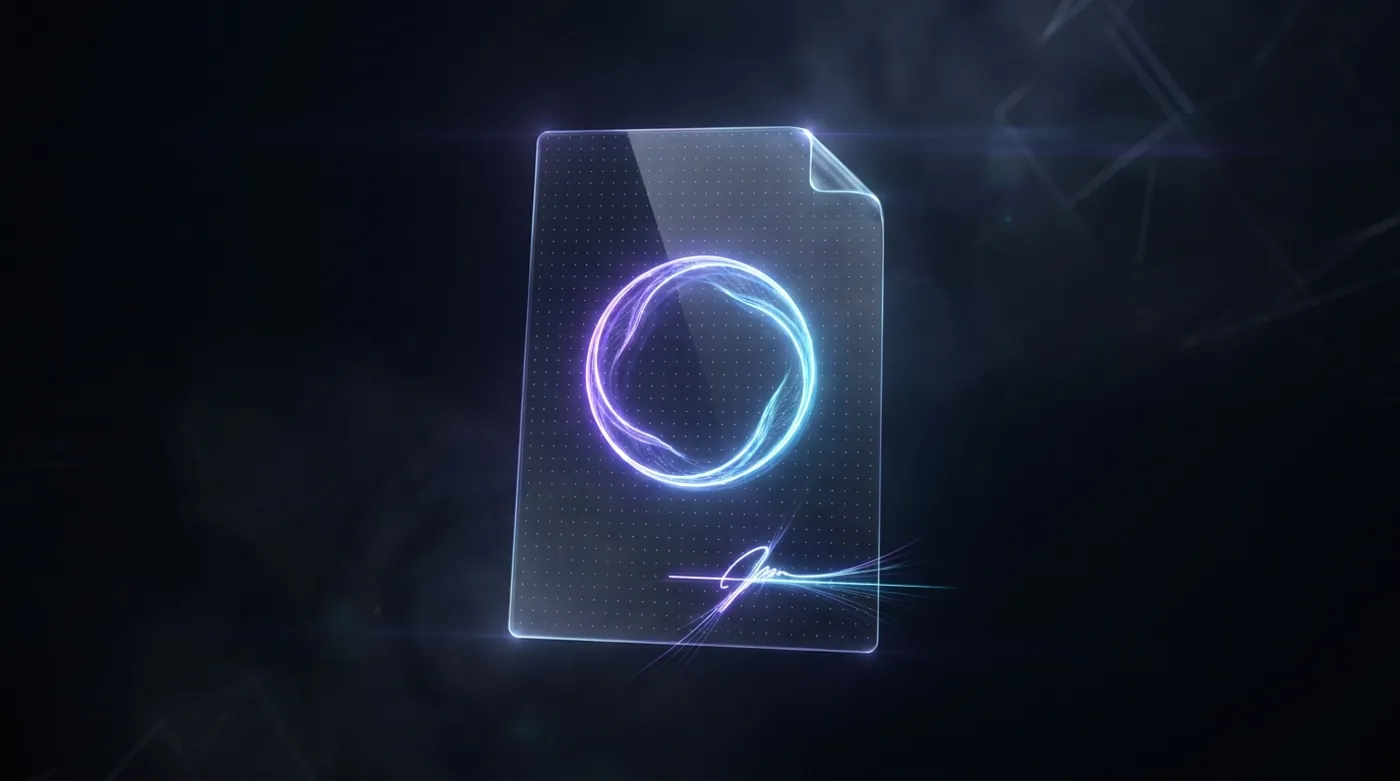
A signed document carrying its own seal
A moment

Veracity Sign

“What was agreed?”

Document signing. Who signed what, in what order, against which version. The completed signing pack then travels on its own: a counterparty or a court can verify it years later, offline, with no account and no call to us.

Asked by — a counterparty, a court

A seal over a stack of controlled versions
Over time

Veracity Assure

“What do the rules require, and were we following them?”

Compliance. Forwards, it walks you to a certification — ISO 42001, CSRD, 21 CFR Part 11 and their kind — each step naming the evidence that satisfies it. Backwards, it proves which version of a policy or control was in force on any past date.

Asked by — an auditor, a regulator

OS holds the knowledge the other two depend on, and everything else besides.
Sign owns the act. It proves a signing ceremony happened, exactly as it happened.
Assure owns the state. It proves which version that act should have been against.

How they fit

One architecture, applied three ways.

The same trust pattern runs through all three — and each is deliberately built for its own job, because a signing pack that must survive on its own in a courtroom needs different foundations from a platform holding a decade of an organisation’s knowledge.

Commercially there are three things to buy. Veracity OS and Veracity Sign are separate products. Veracity Assure runs on top of Veracity OS and is sold on its own.

The claim that holds for every one of them, individually: an outsider can verify it without trusting Veracity.

Why it is hard to copy

Plenty of tools do one piece of this. Nobody holds the set.

In a scan of roughly 124 products across twelve adjacent markets in August 2026, no competitor held more than one of the properties Veracity holds together — and five of them are held by nobody at all.

Checking that a single file has not been altered is now commonplace. Checking a record’s entire history — every version, every approval, every passage an AI quoted back to you — without trusting the vendor, is not.

Who it is for

Trust is not an industry problem. It is an evidence problem — and every regulated industry has it.

Same mechanism; different day it saves you. A deviation investigation that must survive an inspection two years later. An examiner asking which version of a policy was live on a given date. A claim where nobody can prove the instruction was ever issued.

  • Life sciences
  • Financial services
  • Construction & infrastructure
  • Public sector
  • Healthcare
  • Manufacturing
  • Energy & utilities

Where we are — August 2026

Veracity OS
Platform live. Editor, library and verifier; chain of custody; enterprise administration; SharePoint and Confluence import.
Veracity Sign
Launched. Signing engine and offline verifier shipped — a completed pack verifies without contacting us.
Veracity Assure
Module built against a 78-requirement specification. Framework libraries being loaded.